The real benefits (and risks) of anonymous voice chat
By the Switchboard team · July 25, 2026
The short answers, up front
- Talking to strangers measurably improves mood and belonging, and people consistently predict the opposite. That's not a slogan; it's one of the most replicated findings in social psychology.
- Voice builds stronger bonds than text, with none of the extra awkwardness people expect. Tone is most of the message.
- Anonymity is a disinhibitor, and disinhibition cuts both ways: it frees honesty, and it frees abuse. Which one you get depends mostly on the service's design.
- The real safety questions are structural: what a service stores, what the other person can see, and whether report tools work.
- None of this is therapy, and no honest service claims to be.
Is talking to strangers anonymously good for you or bad for you? The question gets asked as if it had one answer. It has two, and they're both well documented. The benefits are real and better supported by research than most people expect. The risks are also real and mostly come down to how a service is built.
We run a phone line that connects strangers by voice, so we have a stake in this. We'll declare that up front, cite our sources, and describe the risks as plainly as the benefits, because we'd rather you understand the trade than swallow a pitch.
The benefits, with receipts
Strangers are better for you than you predict
In a series of nine experiments, Epley and Schroeder1 asked hundreds of commuters to either talk to the stranger next to them or sit in silence. Nearly everyone predicted solitude would be more pleasant. The people told to strike up a conversation enjoyed the ride more, and their conversation partners did too. The researchers called the paper "Mistakenly Seeking Solitude" because the mistake is the finding: we systematically underestimate strangers.
The fear doesn't survive contact either. Follow-up research2 found that the worries people carry into stranger conversations, about rejection, about having nothing to say, reliably fail to materialize once the conversation starts.
Voice carries what text cannot
Kumar and Epley3 had people reconnect and converse through different media. Interactions that included voice created stronger social bonds than text-based ones, and the awkwardness people dreaded never showed up. A voice carries hesitation, warmth, and irony that text flattens into emoji. It's also much harder to treat someone as less than human when you can hear them think.
Weak ties do heavy lifting
Your closest people aren't the whole story. Sandstrom and Dunn4 tracked daily social interactions and found that people are happier and feel more belonging on days with more interactions with acquaintances and strangers, the "weak ties." A conversation outside your circle also gets you something your circle can't provide: a perspective with no history attached.
Anonymity frees the honest version
Psychologist John Suler named this the online disinhibition effect5: when nobody knows who you are, restraint drops. The benign half of that effect is the entire point of anonymous conversation. People say the true thing, ask the embarrassing question, and rehearse the hard conversation, precisely because the listener can't attach it to their name. Australia's eSafety Commissioner6 notes the same duality: identity shielding protects privacy and protects people at risk, even as it complicates accountability.
The risks, honestly
Disinhibition has a toxic half. The same effect Suler described also frees cruelty. Anonymous spaces attract a minority who use the cover to harass, and a service that doesn't remove them curdles fast. Omegle is the cautionary tale; we wrote about what replaced it, and why the camera made its problem worse, in "Omegle alternatives without the camera," linked below.
Privacy exposure is quieter than you think. Your voice is biometric. Anything you post as audio persists as a recording of you, and disinhibition makes oversharing easy: a full name here, a workplace there. The protections that matter are structural, which is why we published a service-by-service breakdown of what "anonymous" actually means, linked below.
Moderation quality varies wildly. "We have a report button" and "reports lead to bans" are different claims. Before trusting a service, find out which one it's making.
And it is conversation, not care. A good talk with a stranger can genuinely help a bad night. It is not counseling, and it doesn't substitute for it. If you need more than a conversation, talk to a professional.
Voice vs text vs identified: the trade-offs
| Format | What tone carries | Disinhibition | What's exposed | Bonds formed |
|---|---|---|---|---|
| Anonymous voice | Everything: warmth, hesitation, irony | High, tempered by hearing a live human | Your voice; identifiers only if the service leaks them | Strong (voice builds bonds text doesn't) |
| Anonymous text | Almost nothing | Highest, in both directions | The least | Weakest |
| Identified voice | Everything | Lowest; reputation restrains everyone | Your identity, by definition | Strong, but limited to people who already know you |
The middle path is the interesting one: anonymous voice keeps the honesty of anonymity and the humanity of a live voice, at the cost of needing a service designed to keep the anonymity real.
How Switchboard approaches safety
Ours, so judge accordingly.
Switchboard is a phone line: you call, an operator asks what's on your mind, and you're connected with another person, one to one. We built for the structural protections above rather than promises. Calls are bridged so neither person ever sees the other's number; people only ever hear first names; conversations between people are never recorded, and only the brief AI-operator setup is AI-processed, which we say plainly. There's no camera by design. You can block or report anyone from the call itself, numbers that violate the rules get banned, and the line is 18+.
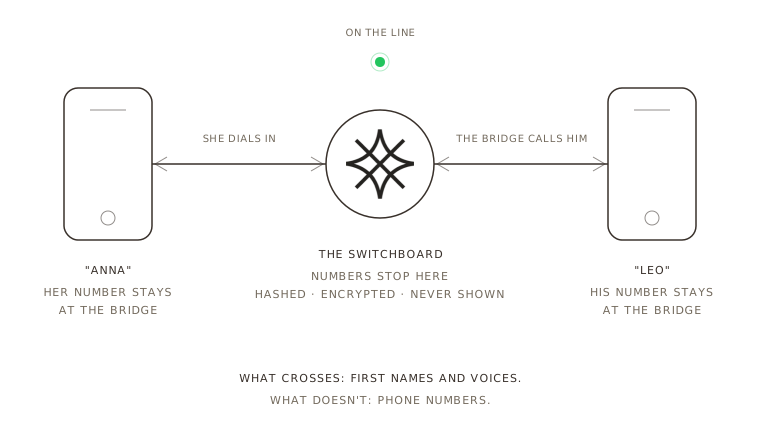
None of that makes a conversation guaranteed to go well. It makes the failure modes smaller, and it means the anonymity doesn't depend on anyone's good behavior, including ours.
The line is open
- Free to call in
- First 30 minutes free
- No app, no account
Questions people ask
- Is anonymous voice chat safe?
- Safer than anonymous video, riskier than talking to people you know. The risk isn't the anonymity itself; it's how a service is built. Look for structural protections: masked identifiers, live audio that isn't stored, working block and report tools, and moderation that actually removes abusers. Then protect yourself: don't share identifying details, and leave any conversation that turns.
- What are the benefits of talking to strangers anonymously?
- Peer-reviewed research finds that conversations with strangers reliably improve mood and belonging, that people systematically overestimate how awkward these conversations will be, and that anonymity lowers the cost of honesty about things you can't say to people who know you. The benefits are real; they come with real risks that depend on the service's design.
- Why does a voice call feel different from texting?
- Because tone is most of the message. In controlled experiments, Kumar and Epley found that interactions with voice created stronger social bonds than text, with none of the extra awkwardness people predicted. A voice carries hesitation, warmth, and irony that text flattens; it's also harder to dehumanize someone you can hear.
- How do platforms protect users in anonymous voice chats?
- The honest mechanisms are structural: routing calls or audio so personal identifiers never reach the other person, not recording live conversations, one-tap block and report, bans that stick, and age gates. Promises of safety without these mechanics are marketing. Ask what a service stores, what the other person can see, and what happens after you hit report.
- Is talking to strangers actually good for you?
- The evidence says yes, on average. Commuters instructed to talk to a stranger enjoyed the ride more than those who sat in silence, in a study people expected to come out the other way. Daily interactions with weak ties predict happiness and belonging. None of this makes any single conversation good; it makes the habit worth having.
- Is anonymous voice chat a replacement for therapy?
- No. Services like the ones discussed here, ours included, are conversation, not care. If you're in crisis or need more than a conversation, talk to a professional or a crisis line. A stranger on the line can be a real comfort; that's different from treatment, and any service that blurs the line is misleading you.
Sources
- 1. Epley & Schroeder (2014), "Mistakenly Seeking Solitude". https://faculty.haas.berkeley.edu/jschroeder/Publications/Epley&Schroeder2014.pdf
- 2. "Hello, stranger?" follow-up research (2021), PubMed. https://pubmed.ncbi.nlm.nih.gov/34618536/
- 3. Kumar & Epley (2021), "It’s surprisingly nice to hear you". https://www.kumar-amit.com/s/Kumar-Epley-in-press-Its-surprisingly-nice-to-hear-you-JEPG.pdf
- 4. Sandstrom & Dunn (2014), on weak ties. https://journals.sagepub.com/doi/abs/10.1177/0146167214529799
- 5. Suler (2004), "The Online Disinhibition Effect". https://journals.sagepub.com/doi/10.1089/1094931041291295
- 6. Australia's eSafety Commissioner, on anonymity and identity shielding. https://www.esafety.gov.au/industry/tech-trends-and-challenges/anonymity
More articles
August 25, 2026 · 8 min
Where can you ask strangers a question and get real answers back?
Forums, listening services, apps, and a phone line: what you ask with, who answers, and which ones answer in a real human voice.
August 20, 2026 · 7 min
Is there a phone number you can call just to talk to someone?
The three kinds of lines where someone answers: crisis lines, warmlines, and social lines. Which one fits, and a number where real strangers answer.
August 5, 2026 · 7 min
Is Switchboard safe to use? A plain-English privacy guide
What Switchboard knows about you, what it never has, how your number stays hidden from the person you talk to, and the limits we won't pretend away.
August 1, 2026 · 9 min
Why talk to strangers anonymously?
What the psychology of anonymity says about why people open up to strangers, plus what to look for in an anonymous voice social network: six features, an evaluation table, and the red flags.
July 25, 2026 · 9 min
The best anonymous voice chat apps in 2026
What "anonymous" and "free" actually mean on Whisperly, StrangerLine, Bubblic, Wakie, and a phone line with masked numbers. No credit card required on any of them.
July 25, 2026 · 8 min
Omegle alternatives without the camera
Omegle is gone. Honest reviews of what replaced it: Wakie, Whisperly, Bubblic, StrangerLine, Chatroulette, and the no-app option, a phone call.
Switchboard — the social utility · articles · how it works · manifesto