The best anonymous voice chat apps in 2026
By the Switchboard team · July 25, 2026 · Updated September 2, 2026
The short answers, up front
- Most "anonymous" chat apps mean one thing by the word: no name required. Your voice, your IP address, and sometimes a stored recording are another matter.
- The strongest anonymity is structural: no account, masked identifiers, nothing recorded. It is not a checkbox in settings.
- Every service reviewed here is free to start, and none requires a credit card to talk.
- Live voice disappears; posted voice persists. If a service stores your voice messages publicly, treat them as public recordings of you.
- A voice is biometric. True anonymity by voice does not exist anywhere; what you're choosing is how much else a service knows.
Omegle taught everyone the wrong lesson about anonymous chat: that anonymity itself is the danger. The real story was the camera. Voice keeps the honesty of a live human and drops the identifying part, which is why anonymous voice chat is having its moment. (We wrote about the wider field in "Omegle alternatives without the camera," linked below.)
But "anonymous" is doing a lot of work in these apps' marketing, and it means five different things on five different services. We run one of them, so we'll declare that up front and review the field honestly, ours included. Before the list, the questions that actually decide how anonymous you are:
- Do you need an account? Every account is a record.
- What do other people see or hear? A username, a first name, a profile with ratings, or nothing.
- Is your voice stored? Live audio evaporates. Posted voice messages are recordings that persist.
- What does the service itself hold? IP address, phone number, transcripts, payment details.
- Do you pay to start? A credit card is your full legal name.
The short version
| Service | Account | What others get | Voice stored? | Card to start? | Weakest link |
|---|---|---|---|---|---|
| Switchboard | No. You just call | First name only; number masked | Never; human calls aren't recorded | No | Your carrier knows you called the line |
| Whisperly | No | Whatever you say | Live only | No | Your IP address, as on any website |
| StrangerLine | No (basics) | Whatever you say | Live only; voice notes persist | No | Video mode sits one tap away |
| Bubblic | Yes | Your voice, publicly, transcribed | Yes. Posts are public recordings | No | "Anonymous" posts are persistent audio of you |
| Wakie | Yes | A profile with ratings and history | Live only | No | The profile is the product |
Switchboard: anonymity by architecture
Ours, so judge accordingly.
Switchboard is a phone line, not an app. You call, an operator asks what's on your mind, and you're connected with another person, one to one. The anonymity is structural rather than promised: there is no account and no profile. Your phone number is your key, stored hashed and encrypted, and the person you talk to never sees it. They hear your first name and whatever you choose to say. Conversations between people are never recorded; only the short AI-operator setup at the start is AI-processed, and we say so plainly. Calling in is free, your first 30 minutes of talk time are free, and no card is asked for at any point before that. 18+.
The honest limits: your carrier's bill shows you called a number, and a first name plus a voice is still you. We think that's the right amount of identity for a real conversation. Enough to be human, too little to be found.
- Good if
- you want anonymity you don't have to configure.
- Less good if
- you want to browse who you'll talk to first.
Whisperly: no-signup roulette, voice or text
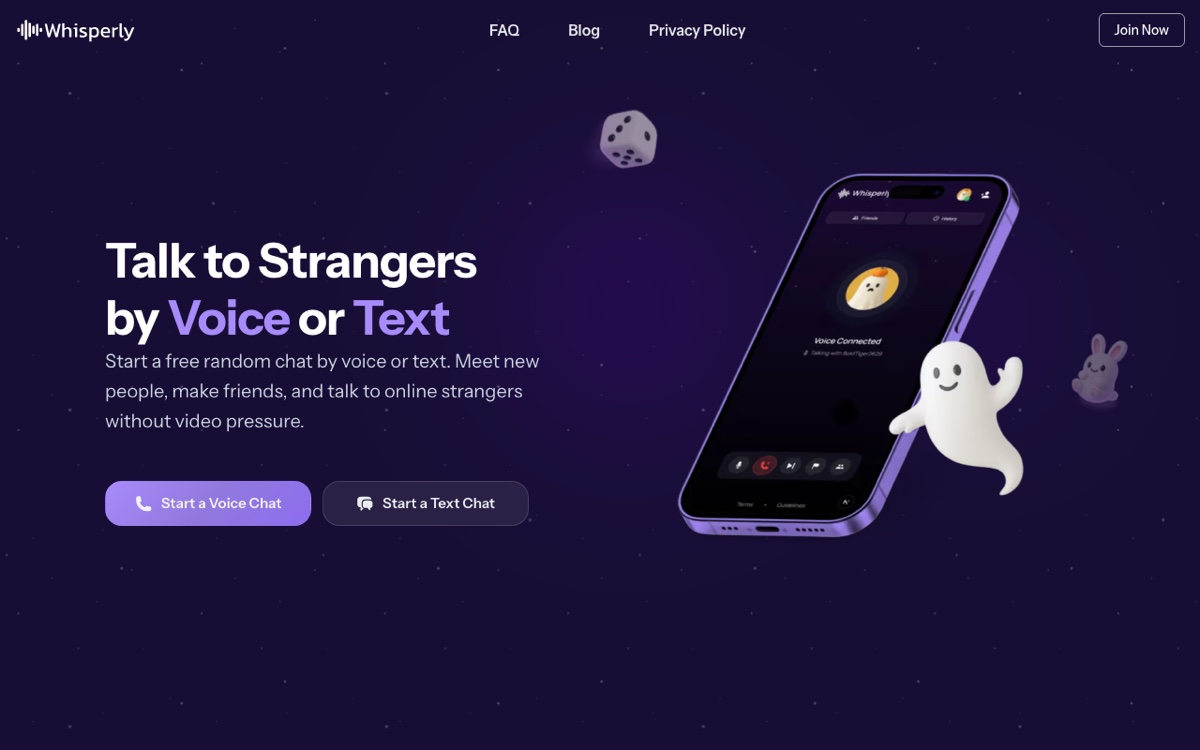
Whisperly1 is the cleanest of the web options: pick voice or text, get matched with a random stranger, no profile required, skip anytime. Nothing persists after the call. Its anonymity is the ordinary web kind: the service sees your IP like any website does, and the person on the line gets only your voice.
Free to start, report tools present, camera absent by design. For drop-in anonymous voice with zero setup in a browser, it's the direct pick.
- Good if
- you want a stranger in a browser tab, now.
- Less good if
- you'd rather no service saw an IP address attached to your late-night thoughts at all.
StrangerLine: anonymous, with an asterisk per feature
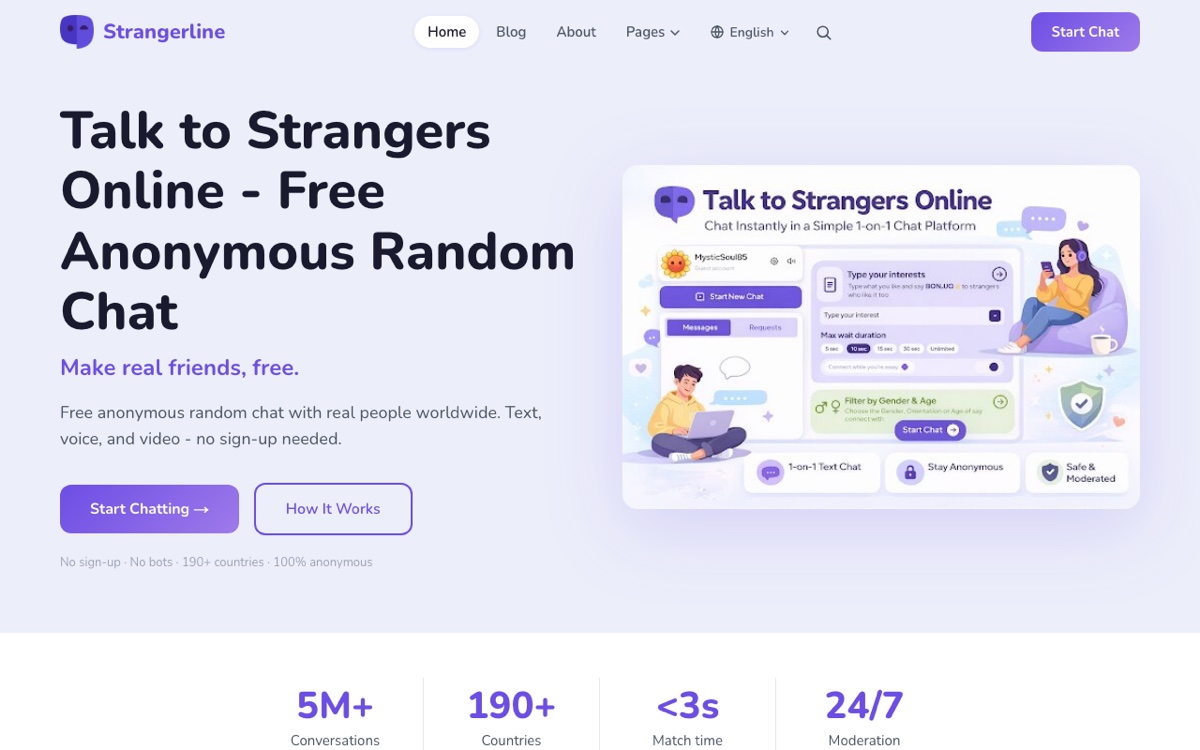
StrangerLine2 covers text, voice calls, voice notes, and video with no registration for the basics, and advertises 24/7 human moderation. Its anonymity varies by feature: live voice evaporates, but voice notes and post-disconnect messages persist by design (that persistence is the feature), and a free account unlocks them. Video, the least anonymous mode there is, sits one tap away.
Used deliberately, voice modes only and no account, it's a reasonable anonymous pick. Used casually, you can wander out of anonymity one feature at a time.
- Good if
- you want options and are deliberate about which you use.
- Less good if
- you want the anonymous path to be the only path.
Bubblic: warm, thoughtful, and the least anonymous of these
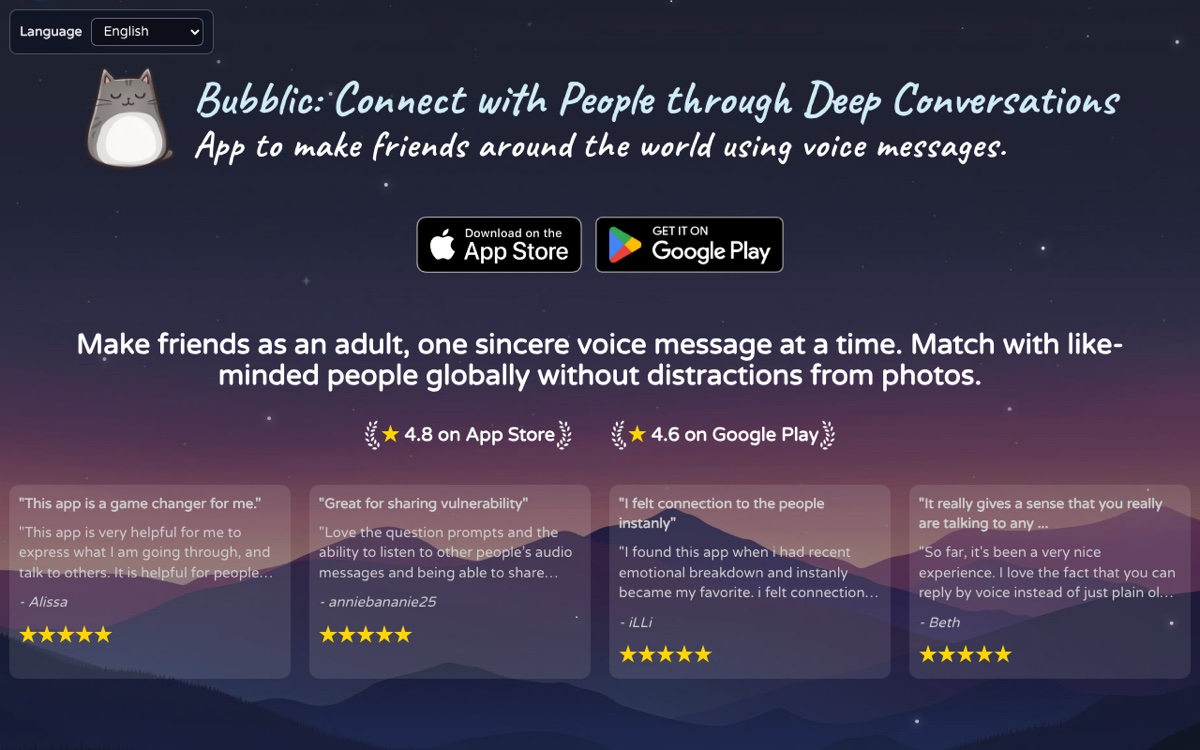
Bubblic3 deserves the honest asterisk. No name or photo is required, which is the sense in which it's anonymous. But the product is posting voice messages: public, transcribed by AI, persistent until removed. Your voice is the most identifying thing about you short of your face, and on Bubblic it's the content. A rough location lands on a world map once, and the community is genuinely kind.
That's not a flaw so much as a different contract: Bubblic trades anonymity for depth, and its users know it. Just don't pick it for anonymity.
- Good if
- you want thoughtful voice conversations and accept being audible on the record.
- Less good if
- "anonymous" is the word that brought you here.
Wakie: pseudonymous, not anonymous
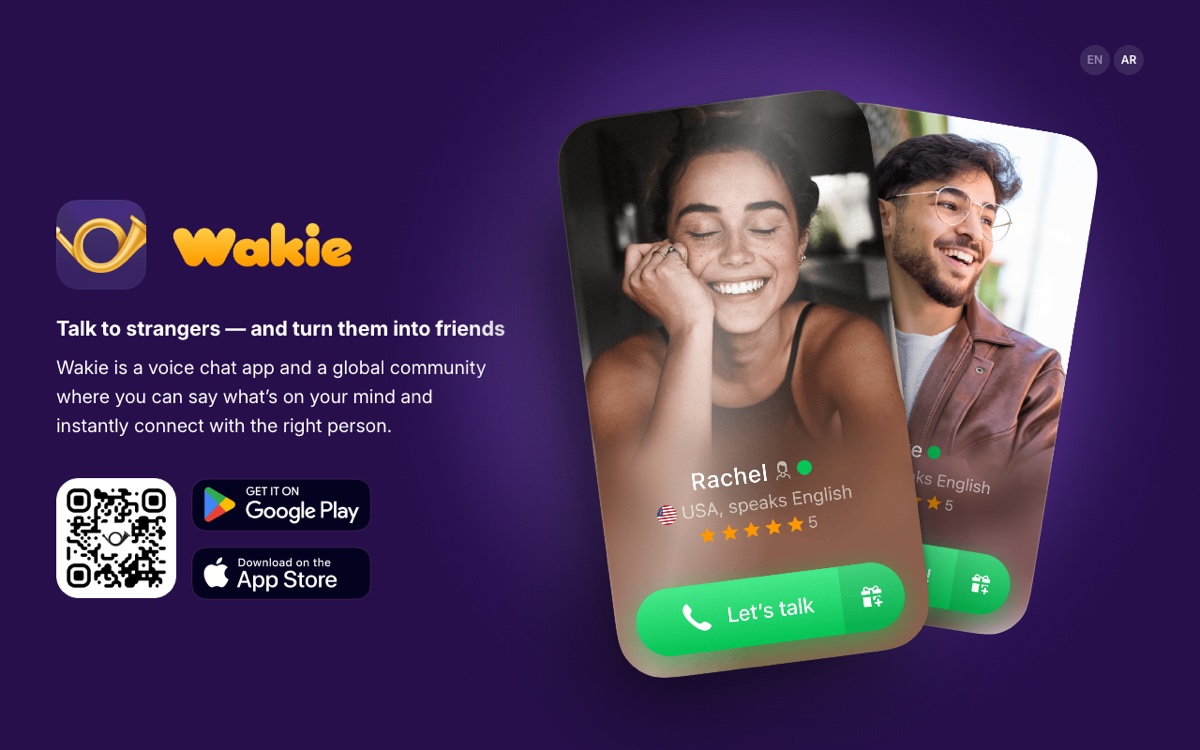
Wakie4 is the veteran of voice-with-strangers, and it's built on profiles: ratings, history, topics, "let's talk" requests you accept or decline. That's pseudonymity, a persistent identity that isn't your legal one. It's also why Wakie feels safe and intentional: everyone has a reputation to lose.
If you want to be a known regular in a voice community, that's Wakie's whole appeal. If you want to be nobody in particular tonight, it's the opposite of the design.
- Good if
- you want ongoing voice friendships under a handle.
- Less good if
- you don't want a handle at all.
Wakie vs Bubblic vs Whisperly: which is best for voice chatting with strangers?
Having reviewed all three above, the honest answer is that they are not three versions of one thing. Each is best at a different kind of conversation, and the comparisons you'll find on the apps' own sites tend to skip that part. Here is the short version, from a site that isn't one of the three.
| App | Best if you want | The catch |
|---|---|---|
| Wakie | Becoming a regular in a voice community, with topic-based calls | Pseudonymous, not anonymous: the profile, with ratings and history, is the product |
| Bubblic | Public voice conversations that persist, closer to a voice forum than a call | Posts are public, transcribed recordings of your voice, indefinitely |
| Whisperly | Instant voice roulette in the browser with no signup at all | Roulette matching: who you get is luck, and there is no memory of anyone |
All three are apps, and all three keep the conversation inside the app's world: a profile on Wakie, a public post on Bubblic, a browser tab on Whisperly. The option none of them offers is the one this page exists to add to the comparison: a private one-to-one conversation over an ordinary phone call, with no app, no account, and both numbers masked. If that is the version you were actually looking for, the line is below.
The line is open
- Free to call in
- First 30 minutes free
- No app, no account
How anonymous voice connections actually work
Worth demystifying, because the mechanics decide the privacy.
Web services (Whisperly, StrangerLine) open a live audio stream between two browsers, usually relayed through the service's servers. Nothing needs to be stored for the conversation to work; your IP and a session are what the service handles. When the tab closes, the conversation is gone.
Phone-line services (Switchboard) work like the telephone network they sit on: you dial a real number, the service bridges your call to another caller's line, and each side's number stays masked because the bridge places the calls, not the participants. No data connection, no browser, no install. The trade: the service must handle phone numbers to place calls at all, which is why how they're stored (hashed, encrypted, never shown) is the question to ask.
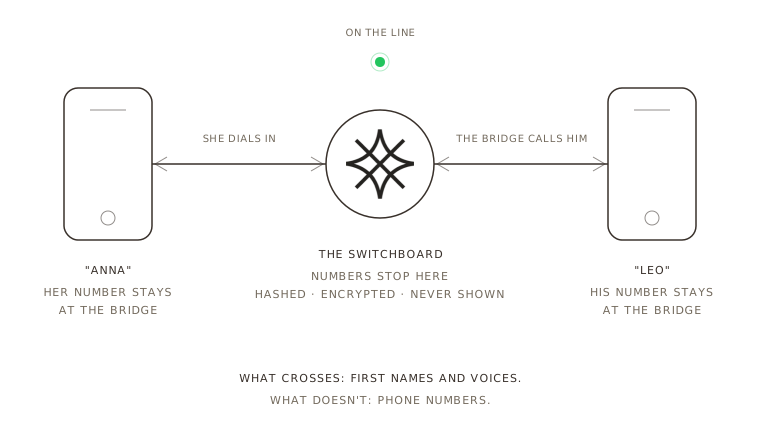
Voice-message services (Bubblic) are different in kind: they store audio and serve it later. That's publishing, not calling. The anonymity question stops being "who can hear me now" and becomes "who can play this later". The answer is anyone, indefinitely.
Are there free anonymous voice chat services with no credit card required?
Yes. All five services reviewed on this page are free to start, and none of them asks for a credit card before you can talk. "Free" still means different things on each, so here is what the free tier actually covers, whether a card ever appears, and what costs money later.
| Service | Free tier covers | Card at signup | What costs money later |
|---|---|---|---|
| Switchboard | Calling in, leaving a voice question, and hearing the answers. First 30 minutes of live talk time included | Never. There is no signup, so there is nowhere to enter one | Optional talk-time top-ups if you keep talking past the included 30 minutes |
| Whisperly | Voice roulette in the browser, no signup | No | Nothing we hit in testing |
| StrangerLine | Text, random and voice chat basics | No | A premium tier for extras |
| Bubblic | The app, posting and replying | No | Optional premium |
| Wakie | The app and calls | No | Optional premium features |
Two free tools that come up in this search deserve an honest aside: Jitsi Meet and Discord. Both offer free voice chat, and Jitsi needs no account at all. But both are built for talking to people you already know: you bring the participants, they do not introduce you to anyone. If the point is meeting a stranger, they answer a different question.
Switchboard's version of free is worth stating precisely, since it is the one we can speak for: calling the line, leaving a voice question, and hearing the answers strangers record for you cost nothing, from any phone, forever. Only live talk time is metered, like a utility, and the first 30 minutes are included. There is no account, so a card cannot be required at signup; one only ever appears if you choose to top up.
If an "anonymous" chat service wants a card before you've said a word, it has already asked for your legal name. Walk.
Questions people ask
- Wakie vs Bubblic vs Whisperly: which is best for voice chatting with strangers?
- It depends on what you want the conversation to be. Wakie is best if you want to become a known regular in a voice community, since accounts carry ratings and history. Bubblic is best if you want public, persistent voice posts, closer to a voice forum than a call. Whisperly is best for instant no-signup voice roulette in the browser. If what you want is a private one-to-one conversation with no app, no account, and no profile anywhere, that is Switchboard: an ordinary phone call with both numbers masked.
- What are the best platforms for anonymous voice conversations in 2026?
- For no-signup live voice in a browser: Whisperly, or StrangerLine's voice modes. For voice with no app and no account at all: Switchboard, over an ordinary phone call with masked numbers. For persistent voice communities: Wakie (pseudonymous) or Bubblic (public voice messages).
- Are there free anonymous voice chat services with no credit card required?
- Yes, all five reviewed here are free to start with no credit card. Whisperly and StrangerLine run in the browser with no signup; Bubblic and Wakie are free apps. Switchboard is free to call (+1 (878) 728-8604 in the US, +358 45 490 3279 in Finland): leaving a question and hearing answers cost nothing, the first 30 minutes of live talk time are included, and because there is no account, there is nowhere to enter a card at all.
- Is there a free anonymous voice chat with no signup or registration?
- Three of the five: Whisperly and StrangerLine work in the browser without registering, and Switchboard has no registration anywhere in the product, since you just dial the number from any phone. Bubblic and Wakie require an account. If avoiding signup is the point, note that a browser session still exposes your IP to the service, while a phone call exposes your number only to Switchboard, never to the person you talk to.
- How do anonymous voice connection services work?
- Web services relay live audio between browsers and store nothing for the call to work. Phone-line services bridge two real phone calls so neither side sees the other's number. Voice-message services store and publish audio, which makes them the least anonymous kind, whatever the sign-up form says.
- What are the privacy considerations for anonymous voice networking sites?
- Five questions: whether an account exists, what other users see, whether voice is stored or only streamed, what the service itself retains (IP, number, transcripts), and whether payment ties your legal identity to the account. Also one uncomfortable fact: your voice is biometric, so "anonymous" always means "anonymous except for being audibly you."
- What should I look for in an anonymous voice social network?
- Structural anonymity over promised anonymity: no account to create, identifiers masked by design, live audio that isn't recorded, moderation and block tools that work, and a business model that sells something other than your data. Minutes, or a premium tier, rather than attention.
- Is Switchboard anonymous?
- Yes, by architecture: no account, numbers masked and stored hashed and encrypted, first names only, and conversations between people never recorded. The setup chat with the AI operator is AI-processed and we say so. 18+.
The line is open
- Free to call in
- First 30 minutes free
- No app, no account
Sources
- 1. Whisperly. https://www.whisperly.live/
- 2. StrangerLine. https://strangerline.io/
- 3. Bubblic. https://www.bubblic.app/
- 4. Wakie. https://wakie.com/
More articles
August 25, 2026 · 8 min
Where can you ask strangers a question and get real answers back?
Forums, listening services, apps, and a phone line: what you ask with, who answers, and which ones answer in a real human voice.
August 20, 2026 · 7 min
Is there a phone number you can call just to talk to someone?
The three kinds of lines where someone answers: crisis lines, warmlines, and social lines. Which one fits, and a number where real strangers answer.
August 5, 2026 · 7 min
Is Switchboard safe to use? A plain-English privacy guide
What Switchboard knows about you, what it never has, how your number stays hidden from the person you talk to, and the limits we won't pretend away.
August 1, 2026 · 9 min
Why talk to strangers anonymously?
What the psychology of anonymity says about why people open up to strangers, plus what to look for in an anonymous voice social network: six features, an evaluation table, and the red flags.
July 25, 2026 · 8 min
The real benefits (and risks) of anonymous voice chat
What the research actually says about talking to strangers by voice: the benefits, the risks, and how to tell a well-designed service from a risky one.
July 25, 2026 · 8 min
Omegle alternatives without the camera
Omegle is gone. Honest reviews of what replaced it: Wakie, Whisperly, Bubblic, StrangerLine, Chatroulette, and the no-app option, a phone call.
Switchboard — the social utility · all articles · how it works · manifesto